| |
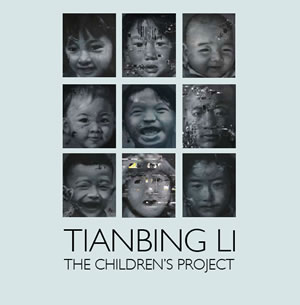
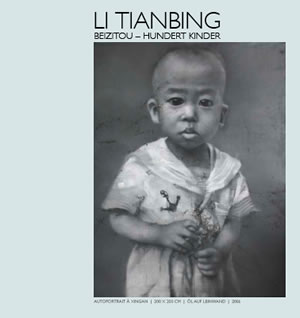
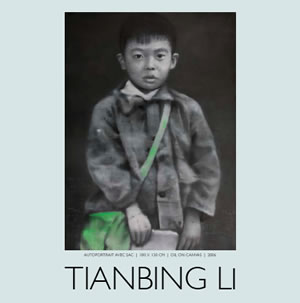
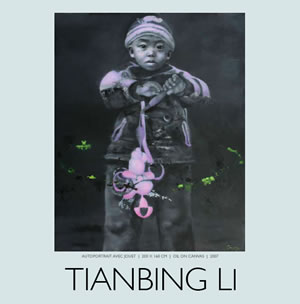
The work of Li Tianbing revolves around this very theme of the one-child policy. Born in the 1970s, the artist relates to the solitude that his generation grew up in. Starting from a few photos of himself as a child, he has reconstructed an ideal childhood animated by imaginary playmates and siblings and then transferred onto canvas. The landscapes are imaginary as well. The artist created them by drawing from an archive of photographs that he took himself of the most remote villages in China, still untouched by the rapid modernization of the country.
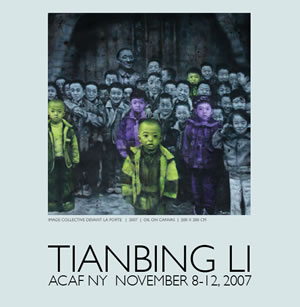
His paintings maintain a strong relationship with photography in the partial blurring, in the overlapping of images that suggest a double impression, in the pose of some of the subjects or in the predominately black and white color. As well, Li Tianbing highlights certain figures by painting them entirely in a uniform color that is symbolically significant to him (blue is the color of capitalism, purple of nostalgia, green of phantoms, light blue of sadness, red of blood and revolution). Even though portraying a fictional world, these paintings offer a scenario closely linked to the socio-political situation in China.
For instance, Recrutement portrays a group of children in a setting that blends Tiananmen Square with a landscape in southern China. It might seem a protest in the eyes of Westerners, who often tend to give a political interpretation to anything that regards China. Instead it is about children who are waiting to be hired for a job in a factory, showing signs with the words “recruitment”. The work emphasizes the fact that the rising inflation in China today makes it more difficult to find workers who accept wage conditions that are inadequate due to the increased cost of living, and that consequently the factories find it difficult to cope with the huge demand for products that maintain competitive prices. In addition, many Chinese prefer to return to live in suburban and rural areas, where the negative effects of inflation are not felt as much. The Chinese population policy is no stranger to this labour shortage. It is believed, in fact, that there have been approximately 400,000,000 fewer births since the enactment of the 1978 law forbidding a couple to have more than one child.
____________________________________________
Tianbing Li builds bridges between East and West by merging motifs and techniques from traditional Chinese painting with elements of western iconography. Exploring a wide variety of different painting techniques, the artist finds subtle ways to express his socio-critical views on contemporary Chinese society. In his most recent “My Other Childhood” series Tianbing Li is addressing China’s one-child policy from a different angle. Many of these large-scale portraits show the artist with his imaginary brother. Li used two photographs of himself taken at different ages and combined them on one canvas. The artist describes his own childhood as very bleak and lonely lacking playmates and toys, so by creating imaginary siblings on the canvas or by adding colourful toys Li can reinvent the past and relive his – now improved – childhood. Tianbing Li puts great emphasis on an emotional and artistic approach to his works despite their socio-critical content. He is therefore not constructing overly complex paintings but creates atmospheric pieces, which enable the viewer to access the works emotionally. Li has deliberately not confined himself to a single painting style as he feels that it is only through stylistic variations that he is able to explore the boundaries of the medium. This approach also reflects the artist’s cultural background, rooted in the Eastern philosophy that all things are in a constant state of flux. The ongoing advancement of the “self” thus finds its reflection in Tianbing Li’s ever-changing artistic expression.

Tianbing
Li treads the line separating two dramatically different
worlds: the China of his ancestral past and the
China of the present. “I feel impelled to do
this: all artists have a need to distance themselves
from the world they live in to facilitate conditions
conductive to reflection – otherwise they die”.
The motivations underlying all of Li’s work
are best characterized by an ongoing dialogue between
old and new, between ancestral and modern, between
the realities of China, on the one hand, and those
of the European continent on the other.
“I created this series of canvases using ancient
Chinese painting as a model. Each piece is composed
using ancestral techniques.” However, as one
approaches the work it becomes evident that Li’s
content is contemporary. The blacks, whites and
browns traditionally used give way to a modern palate
– an allegory for the influences of western
culture on present day China. Li’s images echo
this theme: plants become parts of human bodies,
insects transform into toys and other industrial
products. “In an ironic fashion, I express
in my paintings what is taking place in China today,
where long-held traditions are little by little
being eroded by the invasion of a consumer society
and it is becoming subsequently, a world submerged
in desire and yearning”.
INTERVIEW WITH ULI SIGG
ESSAY BY RANDY ROSEN
LI TIANBING : UN DIALOGUE AVEC LES FANTOMES.
IN THE NAME OF THE BRAND
LI TIANBING WITH THE CHARACTER OF PORTRAIT
AN INTERVIEW WITH LI TIANBING |